They say, tell and relate that in 609 AD, Pope Boniface IV established 13th May as All Saints' Day. About 130 years later, Pope Gregory III consecrated a chapel in St Peter's Basilica in Rome to all martyrs on 1st November and decreed that the Feast of All Saints would henceforth be held on that day. Surprisingly, this dictate seems to have applied only to the Diocese of Rome. When Pope Gregory IV assumed the Throne of St Peter (827-844), he extended the decree to all the dioceses.
There is a school of thought that this action, along with similar directives, aimed to suppress pagan celebrations and, by default, the pagan people, replacing them with Christian observances. Who would think that could even be possible!?
Interestingly, the Green Man, whose image appears prominently in many medieval bench-end carvings, shows that not all the 'Old Ways' were so easily eradicated.
The word Samhain comes from the Old Irish 'samain', meaning 'summer's end', formed by combining 'sam' ('summer') and 'fuin' ('end'). Whilst Samhain is the name of the ancient Celtic festival, it is a Gaelic word native to Scotland, Ireland and the Isle of Man. The Celtic calendar differed from the Anglo-Saxon one brought by European settlers. This Germanic calendar divided the year into twelve, sometimes thirteen, lunar months.
We learn this from the Jarrow-based Northumbrian eighth-century theologian, chronologist, scholar, fountain of knowledge and Benedictine monk, the Venerable Bede, who, once he had finished his mighty tome, The Ecclesiastical History of the English People - a history of the Anglo-Saxon tribes' conversion to Christianity - turned his attention to something a little more light-hearted and produced what he called:
'Our Little Book about the fleeting and wave-tossed course of Time'.
A rather evocative title, I think.
In this work, we learn that November was known as Blōtmonath, which means 'the month of blood sacrifices'. Both cultures commonly culled livestock around this time of year for a number of reasons. During the cold winter months, there would have been a lack of forage, and keeping weak livestock over the winter would have been a waste of valuable resources. Culling at this time of year, also provided food for the winter months. This was also the time when some animals were sacrificed in the hope that both people and animals would survive until the lighter days returned.
The 1st of November was the traditional day of celebration, but the Celts and the Anglo-Saxons, like many other cultures of the time, believed that the veil between this world and the next was thinnest on the night before, and that the souls of the dead roamed this world again. To appease these wanderers, people generally left food and drink outside their homes as offerings to ensure their safety and that of their animals through the coming winter. Often, people set an extra place at the table, believing that deceased relatives might wish to visit. It was also not uncommon for people to dress up to disguise themselves and confuse the spirits.
As Christianity spread gradually, the early Church, in line with its policy of Christianisation, decreed that the night before All Saints' Day should be called All Hallows' Eve - 'Hallow' derives from the Old English word 'halga', meaning 'holy one' - and that the day following All Saints' Day should be known as All Souls' Day. Saints and sinners, so it covers all bases!
Part of the medieval celebrations took place on 2 November, when 'souling' occurred. This involved the poor of the community visiting their better-off neighbours and singing, or sometimes acting out a small play, in return for Soul Cakes. They would also guarantee to pray for the souls of the givers and their dead relatives. This was very important during this period, as it was believed that the dead needed prayers from the living to free them from purgatory.
The motivation for giving out the Soul Cakes would have been a good return for the prayers, and this practice may well have become the forerunner of carolling and figgy pudding.
In 1604, Elinor Fettiplace wrote her recipe for Soul Cakes in her Receipt Book.
'Take flower & sugar & nutmeg & cloves & mace & sweet butter & sack & a little ale barme, beat your spice, & put in your butter & your sack, cold, then work it well all together, & make it in little cakes, & so bake them, if you will you may put in some saffron into them and fruit'.
If you think you might like to have a go at making some Soul Cakes, ale barme is the froth that forms on the surface during ale fermentation. It is yeast-rich, and bakers used it for centuries to leaven dough. If you are searching for sack, look no further than that bottle of Harvey's Bristol Cream that has been skulking in the back of the sideboard cupboard since Christmas at least three years ago - the modern equivalent of sack, a fortified sweet wine from Spain.
If you do have a go at making Soul Cakes, do let me know how they turn out!
With roots anchored deep in our agricultural past, I think the Feast of All Saints, Samhain and Blōtmonath remain relevant today because of those deep distant roots, despite the metamorphosis of Halloween into a Plastic-Tat Fest. As we finally leave behind the summer days of light and the harvest is well and truly 'in', the Wheel of the Year turns, moving us into the dark days of winter. It is part of nature's ongoing cycle of birth, death and rebirth.
Although many of us are no longer as governed by the changing seasons as we once were - apart from, obviously, our many hardworking farming friends - our ancestors knew that perhaps the best way to spend the dark days of winter over the next few months was to hunker down, light the fire and start wintering. So perhaps we should do the same.
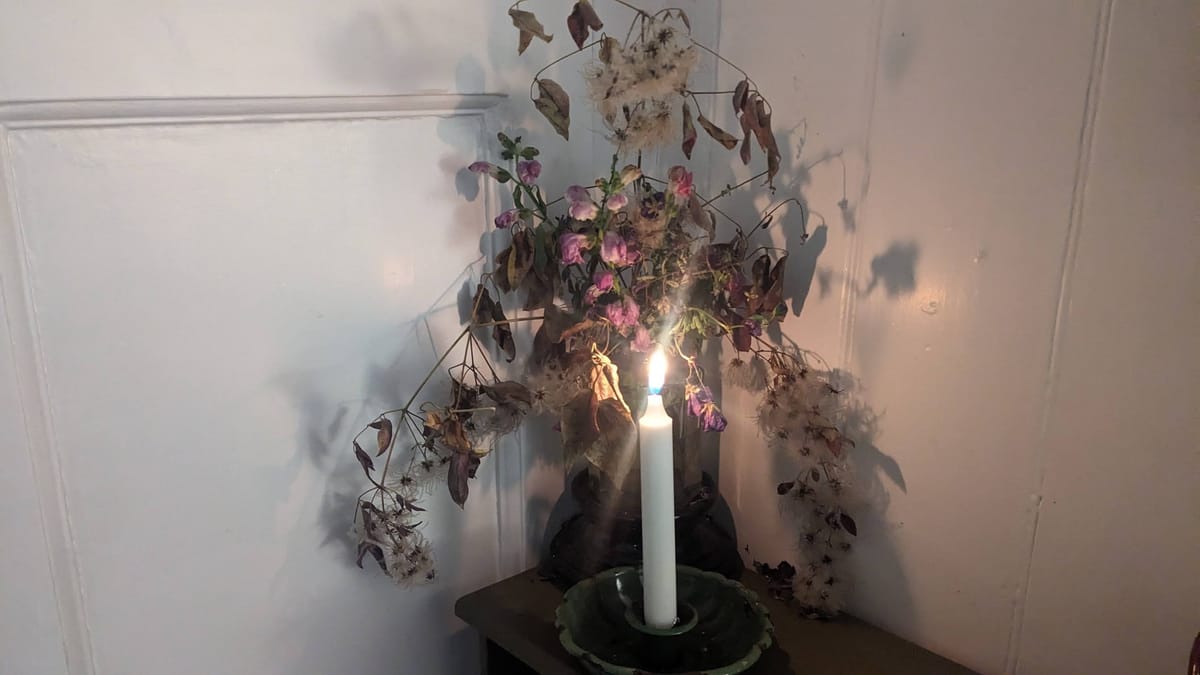
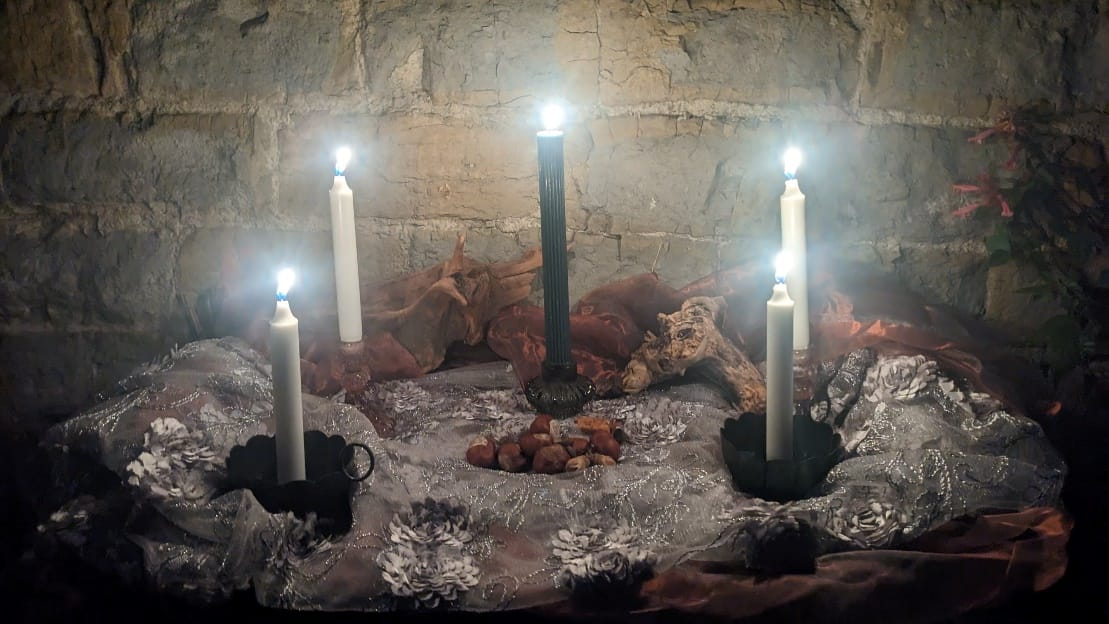
As this October draws to a close, why not follow the Rooted & Rural plan for All Hallows' Eve? Light some candles, add another log to the fire, perhaps pour yourself a glass of last year's blackberry liqueur, and snuggle up with a good book.